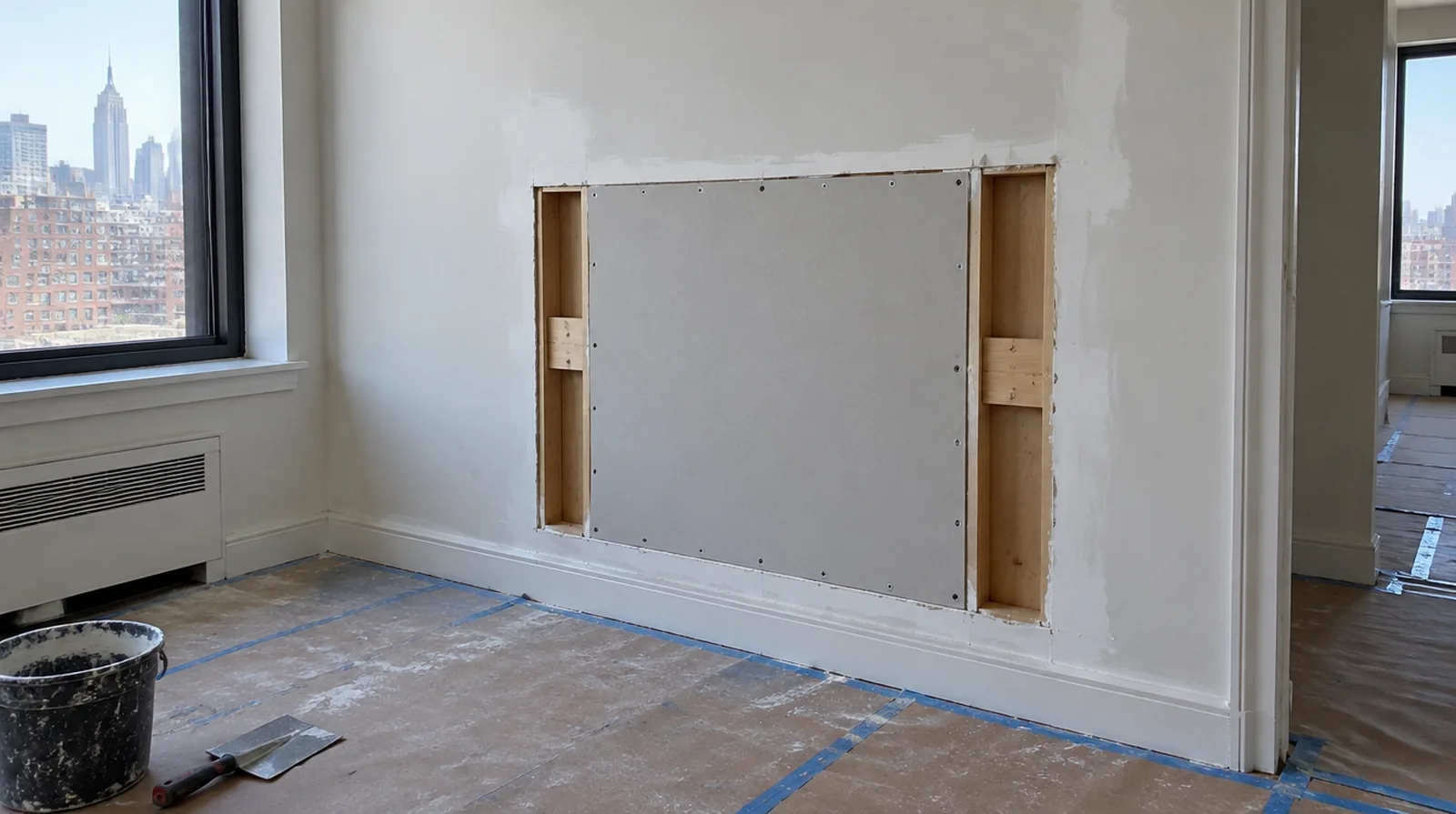
Support the replacement
A substantial hole is normally rebuilt with board and proper support, not filled entirely with finishing material. The replacement thickness of the board should match the original face so the joint can finish level. When more damage could be hidden, ask how any added scope will be documented before extra material is removed or replaced.
Handle small fastener marks
A noticeable screw or nail bump can indicate movement between the board and its supporting framing. Adding appropriate fastening nearby may be necessary before the damaged spot receives finishing compound. For a planned new wall mounted fixture, resolve its backing requirements while the cavity remains open instead of cutting into completed drywall later.
Identify the cause
A dent from moving furniture calls for a different repair than a joint that repeatedly opens beside a door. Describe any change in the defect and check whether the surrounding board is still stable. For a project involving a building manager, confirm access hours and protection requirements before promising a start date or a short completion window.
Set the paint boundary
Even a well blended patch can remain visible when touched up with an aged or unavailable paint color. Consider a corner to corner decorative boundary when color or sheen differences would otherwise remain noticeable. For a project involving a building manager, confirm access hours and protection requirements before promising a start date or a short completion window.
Review with side lighting
A patch that looks flat from the doorway may still show a small hollow under a nearby window. Window light may reveal a contour that ordinary room lighting hides, while decorative paint sheen creates a separate issue. Where the wall meets fixed furniture, clarify whether removal is included or whether the finish will terminate at the accessible edge.
Document recurring movement
A crack that repeatedly reappears could need the cause investigated before more cosmetic work. State any moisture or movement concerns that another professional must resolve ahead of the drywall repair. When the protected room includes a doorway, check the clearance for panel movement as well as the amount of space available for finishing tools.
Protect adjacent surfaces
Fine gypsum dust can travel beyond the immediate patch unless floors and nearby furnishings are protected. The work plan should identify what needs moving and which room can remain in use. For a project with several trades, agree which inspection or handover point must happen before the next person starts work.
Reinforce panel seams
Joint tape bridges the transition between the original wall and a replacement section. Embed the chosen tape fully in its intended compound so the edges bond without bubbles. At an edge beside built in furniture, state whether the obstruction will be removed or whether finishing stops at the section that can be reached.
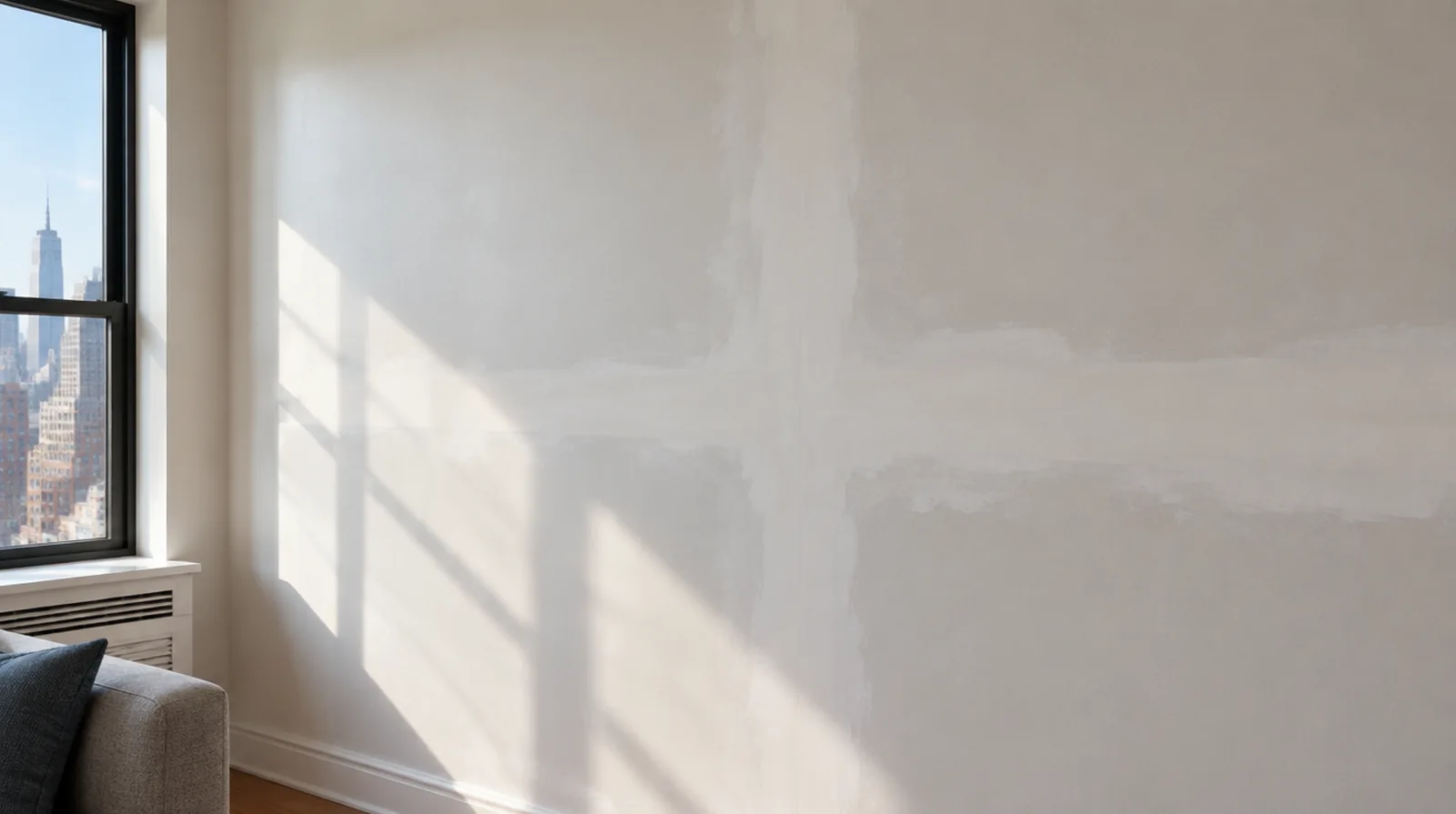
Build thin finishing coats
Shaping a repair through thinner coats gives more control than depositing all the material at once. Each layer needs adequate drying time before the next pass can be judged accurately. Where flooring is staying in place, agree on protective coverings and check that tools and material handling will not damage the noticeable finish.
Prepare for primer
Fresh compound and existing painted drywall absorb coatings differently unless the repair receives suitable primer. Establish whether suitable primer is part of the repair or will be applied by another contractor. For a planned new wall mounted fixture, resolve its backing requirements while the cavity remains open instead of cutting into completed drywall later.
Project context in New York
Ask about lift reservations, shared corridor protection and the space available to turn a full board at the apartment entrance. Inside the room, tall windows can send light across a long wall and reveal a poorly feathered transition.
Scope questions before finishing
Where a surface has been painted many times, consider whether differences in texture or sheen will require a wider decorative treatment.
At an edge beside built in furniture, state whether the obstruction will be removed or whether finishing stops at the section that can be reached.
When a wall has repeated defects, keep a record of earlier repair attempts so a new assessment does not simply repeat an unsuccessful approach.
If occupancy must resume on a certain day, include the later primer and paint stages in the timetable as well as drywall installation and finishing.
If the current finish is unusual, keep a small reference sample or a close photograph to support the discussion about blending and restoration.
When damage followed other building work, describe the nearby alterations and the sequence between those changes and the first visible defect.
When the project space includes a doorway, check the clearance for panel movement as well as the amount of space available for finishing tools.
Where flooring is staying in place, agree on protective coverings and check that tools and material handling will not damage the visible finish.
If the coating stability is unclear, assess which layers are adequately bonded and which ought to be removed rather than simply hidden beneath new material.
If the project is part of a larger remodel, settle the sequence with flooring, trim and cabinet work before setting a final finishing date.
When the wall surface has strong reflected light, look at the full plane rather than judging only the narrow strip immediately beside the patch.
For a repair that crosses several surfaces, measure the affected planes separately so the estimate can explain where each finishing treatment starts and stops.
Explore the New York drywall overview for related options, or read the project planning information before arranging the next stage.
More planning details for New York
A New York apartment project can be constrained by the route into the room before the size of the repair matters. A measured sketch of the route is more useful than assuming that a sheet fitting the wall will fit the building. Discuss that viewing angle before choosing the finishing boundary.